Two-Bite Banana Split Bites (and the Feelings We Name While We Make Them)

I didn’t plan for bananas to become a feelings tool.
But that’s what happened, somewhere between a sticky counter and a three-year-old who couldn’t decide if she was excited or scared about the first day of preschool. She kept telling me her tummy was “weird.” Not sick. Not hungry. Just weird.
I cut up a banana. Gave her the knife (the safe plastic one). And somewhere between the third and fourth slice, she said, “Maybe my tummy feels like it has more than one feeling in it.”
That’s the moment this recipe exists for.
Why I love this one
Two-Bite Banana Split Bites are less of a recipe and more of a permission slip. They’re small. They’re bright. Every bite looks like a tiny dessert. They take less than ten minutes and they don’t require heat, dexterity, or your full executive function at 4 PM.
What they’re really good at is giving you something to do with your hands while you and your kid have a conversation neither of you planned to have.
Because the thing is — kids don’t usually open up when we sit them down and ask how they’re feeling. They open up when we’re busy. When the pressure is off. When we’re doing something small and doable, side by side.
What you need
- 2 ripe bananas (the ones with little brown freckles work best)
- ⅓ cup strawberry yogurt — or plain Greek yogurt with a spoonful of strawberry jam stirred in
- 2 graham crackers, crushed into “sand” in a sandwich bag
- Mini chocolate chips
- Optional: a little whipped cream
That’s it. No measuring cups. No oven. Nothing that has to turn out right.
How we make them
- Slice the banana into coins, about half an inch thick. (If your kid is three, they get to smush the banana with the back of a spoon instead. Same energy.)
- Put a little dollop of strawberry yogurt on top of each coin.
- Roll the yogurt edge in the graham cracker sand — this is the part where hands get sticky and conversation gets honest.
- Top with a few mini chocolate chips.
- Whipped cream if you’re feeling fancy. A fingerprint in the whipped cream if you’re three.
Serve two per plate. Call them bites. Call them snacks. Call them whatever keeps the moment soft.
The part that took me years to learn
The recipe is not the point.
The point is what happens while you’re making it.
Somewhere between slicing and sprinkling, kids will say things they wouldn’t say at the dinner table. About their day. About a friend. About the thing that’s been sitting in their tummy all afternoon making it feel weird.
And when they do — the best thing I’ve learned to say is almost nothing.
I just name it back.
“Oh. So you felt left out at the snack table.”
“Oh. So it was exciting and kind of scary.”
“Oh. Sometimes two feelings can live in the same tummy.”
Not a lecture. Not a lesson. Just a mirror with graham cracker crumbs on it.
The thing I had to un-learn
For a long time, when my kid told me something felt weird — in her tummy, in her chest, in her head — my instinct was to fix it. Offer a solution. Talk it through. Reassure her it was going to be okay.
It was well-meaning. It also didn’t help.
What helped was shockingly smaller. I just stopped trying to move the feeling. I let it sit there, named it once, and went back to slicing bananas.
Somewhere in the ten minutes it takes to make these bites together, her tummy would stop feeling weird. Not because I fixed anything. Because the feeling had been given a name and a place, and that was enough for a three-year-old to carry it.
That’s the whole thing, honestly. Small feelings, small food, small amounts of talking.
A gentle note on “picky”
If you have a kid who doesn’t love bananas, doesn’t love yogurt, or doesn’t love anything squishy — that’s fine. Swap the banana for apple coins. Swap the yogurt for peanut butter. Swap the graham for crushed pretzels.
The pattern is what matters: something soft, something crunchy, something sweet, something small enough to feel doable.
Small things, said out loud, in a small kitchen. That’s the whole recipe.
If you’re doing the book-plus-recipe thing
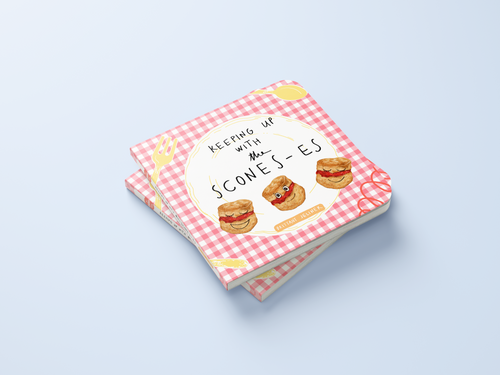
This one pairs beautifully with Keeping Up With the Scones-es — the book in our series about a scone named Joan who can see all the other scones she could be, and isn’t sure how to feel about it.
Read it first. Then make the bites. Then — and this is the part parents tell me they didn’t expect — watch what your kid says when they’re assembling the coins.
They’ll bring it up. They always do.
Because somewhere around bite two, their tummy has already decided it’s safe to say what it’s been carrying.
And that, to me, is what a recipe is supposed to do.
— Brittany